You will usually start exercises after knee replacement in the hospital, where your orthopaedic surgeon and physiotherapist will guide you.
Once you leave the hospital, you will need to continue your exercises at home. Your physiotherapist will check your knee replacement recovery and help you move to harder exercises when you are ready. But which exercises should you do, and when should you start them?
In this guide, I’ll explain the exercises from week 1 to week 12, how physiotherapy after knee replacement supports recovery and when professional supervision is important.
Why are exercises important after knee replacement?
During total knee replacement surgery, the damaged parts of your knee joint are replaced with artificial parts. After surgery, the muscles around your knee may still be weak. Pain and swelling can also make it hard to move your knee.
Regular exercises after knee replacement can help you:
- Improve knee bending and straightening.
- Strengthen the thigh, hip, and lower-leg muscles.
- Improve walking and balance.
- Reduce stiffness and improve joint mobility.
- Regain confidence in activities such as sitting, standing, and climbing stairs.
Exercises after knee surgery usually begin on the day of surgery or the following day, depending on your medical condition.
Your physiotherapist will guide you through these exercises in the hospital and show you how to do them safely at home.
Week 1–2: Gentle movement and muscle activation
Goal: Improve circulation, activate muscles, restore knee movement, and begin walking safely.
Exercises after total knee replacement surgery usually start within 24 hours, depending on your medical condition.
Your physiotherapist will initially supervise these movements and teach you how to continue them safely after discharge.
1. Ankle pumps
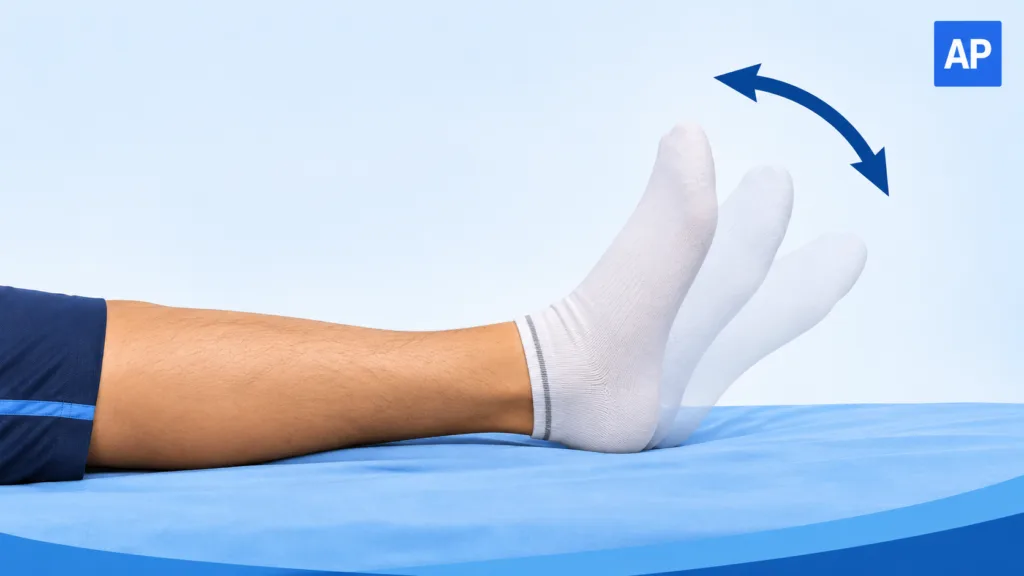
Ankle pumps encourage blood circulation in the lower legs and help reduce the effects of prolonged inactivity.
How to perform:
- Lie down or sit comfortably.
- Pull your toes upwards towards your body.
- Point your toes downwards.
- Continue moving your feet rhythmically.
Perform ankle pumps frequently while awake, as instructed.
2. Quadriceps sets
The quadriceps are the muscles at the front of your thigh. They help straighten the knee and provide stability while walking.
How to perform:
- Lie with your operated leg straight.
- Tighten your thigh muscles.
- Try to press the back of your knee towards the bed.
- Hold for 5–10 seconds, then relax.
Your physiotherapist may initially recommend around 10 repetitions, with rest between sets.
3. Heel slides
Heel slides are among the most important knee bending exercises after surgery. They help improve knee flexion, which is the movement needed to bend your knee.
How to perform:
- Lie on your back with your legs straight.
- Slowly slide your operated heel towards your buttocks.
- Bend your knee as far as comfortably possible.
- Hold for 5–10 seconds.
- Slide your heel forwards to straighten the leg.
Do not force your knee into a painful position.
4. Knee straightening exercises
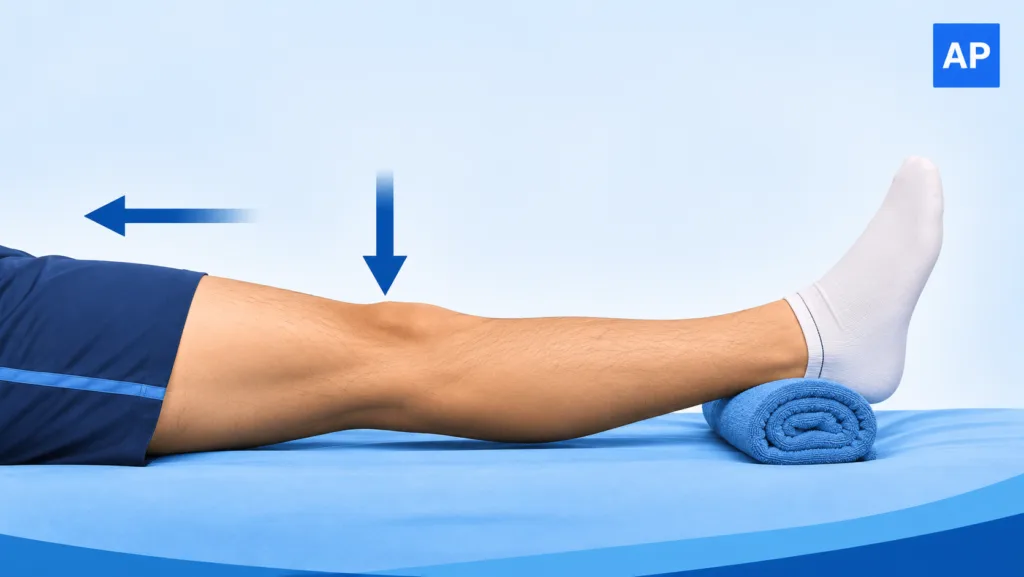
Knee extension means straightening your knee. Regaining this movement is important for walking with a normal pattern.
How to perform:
- Lie on your back.
- Place a small rolled towel beneath your ankle, leaving the knee unsupported.
- Tighten your thigh muscles and gently straighten the knee.
- Hold for 5–10 seconds, then relax.
Avoid resting with a pillow directly beneath your knee for prolonged periods.
5. Straight leg raises
This exercise strengthens your quadriceps and may begin early if you have sufficient muscle control.
How to perform:
- Lie down with your operated leg straight.
- Tighten your thigh muscles.
- Lift the leg a few inches without bending your knee.
- Hold briefly and lower slowly.
If you cannot keep your knee straight, ask your physiotherapist for assistance.
6. Seated knee bends
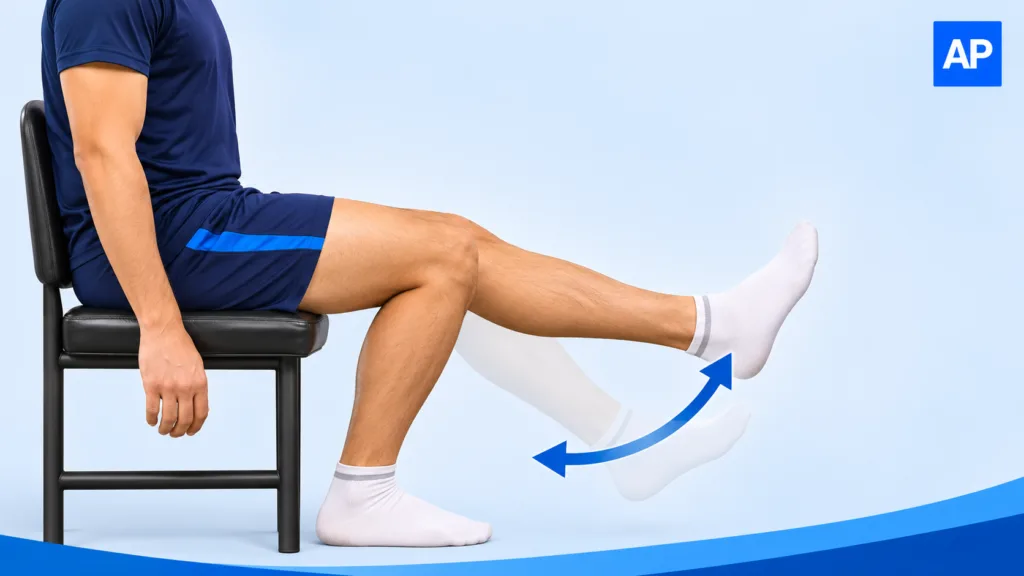
Seated knee bends can also begin during early recovery when your physiotherapist considers them suitable.
How to perform:
- Sit on a stable chair.
- Slowly slide your operated foot backwards.
- Bend your knee as far as comfortable.
- Hold briefly, then return.
You may use your other leg to provide gentle assistance if instructed by your physiotherapist.
Walking during weeks 1–2
Walking usually begins soon after surgery with a walker or crutches.
Initially, you should focus on taking short, controlled steps rather than walking long distances.
Try to place your heel on the ground first, move your weight smoothly over the foot, and then lift your toes as you take the next step.
Follow your surgeon’s instructions about how much weight you can place on your operated leg.
Week 3–4: Improving knee flexibility and strength
Goal: Improve knee movement, strengthen muscles, and practise basic daily activities.
Continue your prescribed heel slides, quadriceps sets, knee extension exercises, and straight leg raises.
Depending on your progress, your physiotherapist may add the following exercises.
1. Seated knee extensions
Seated knee extensions strengthen the quadriceps and improve control while straightening the leg.
How to perform:
- Sit upright on a chair.
- Slowly straighten your operated knee.
- Hold briefly.
- Lower your foot with control.
Avoid swinging your leg.
2. Standing heel raises
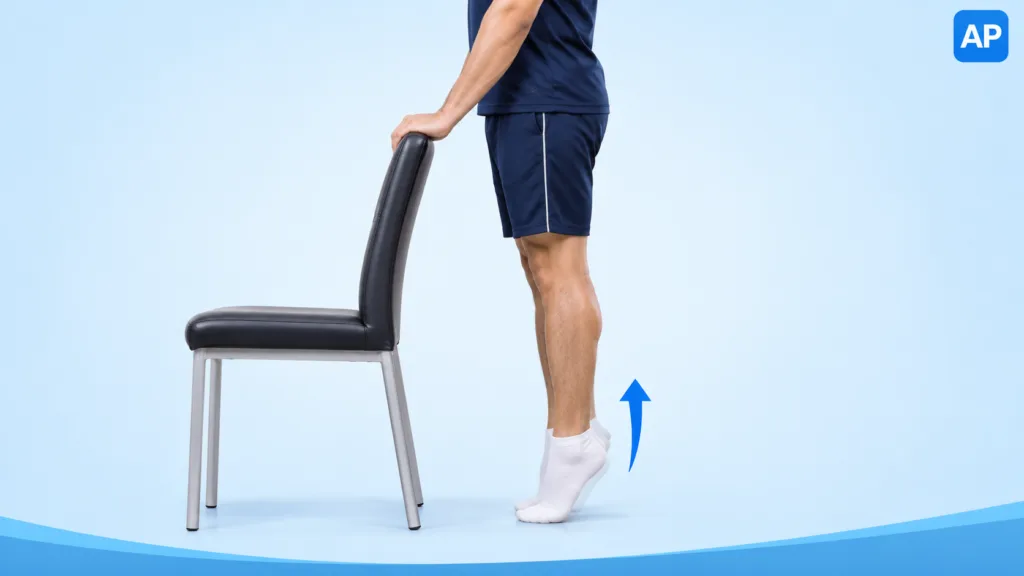
Heel raises strengthen your calf muscles, which support walking and balance.
How to perform:
- Stand holding a stable support.
- Slowly lift both heels off the floor.
- Rise onto your toes.
- Lower your heels gently.
Avoid leaning forwards or losing your balance.
3. Standing knee bends
This exercise helps improve knee movement while standing.
How to perform:
- Hold a stable support.
- Bend your operated knee, lifting your foot behind you.
- Hold briefly.
- Slowly lower your foot.
Avoid leaning forwards.
4. Mini squats
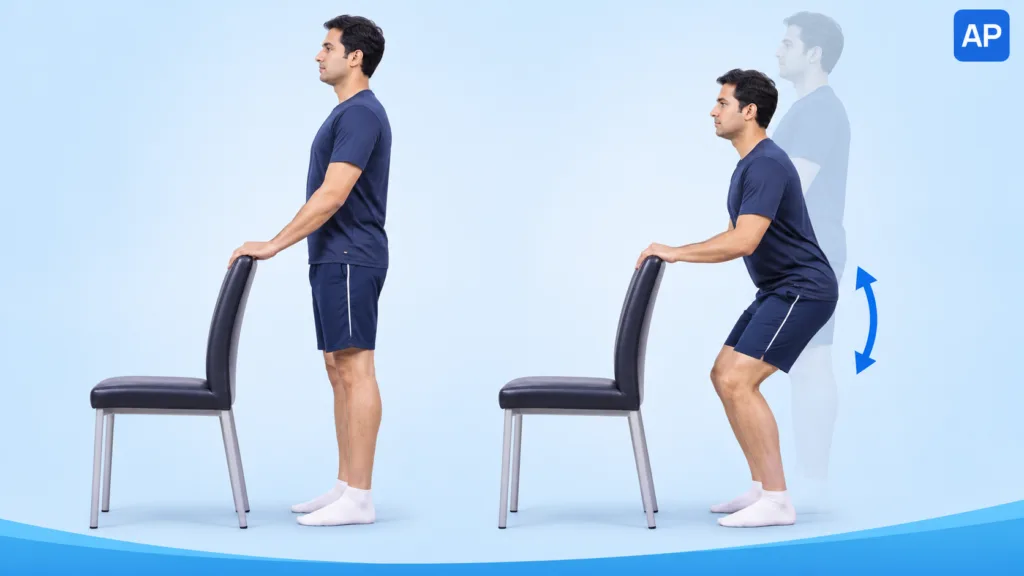
Mini squats help strengthen the thigh and hip muscles.
They may be introduced during this stage if you have enough strength and balance.
How to perform:
- Stand with your feet hip-width apart.
- Hold a stable support.
- Bend your knees slightly while moving your hips backwards.
- Return slowly to standing.
Keep the movement shallow and comfortable.
5. Sit-to-stand
Standing up from a chair is an important daily activity that requires knee movement, strength, and balance.
How to perform:
- Sit on a firm chair.
- Keep both feet on the floor.
- Lean forwards slightly.
- Push through your feet and stand up, using your hands if needed.
- Slowly sit down again.
A higher chair may make this exercise easier initially.
Week 5–6: Progressive strengthening
Goal: Build strength, improve walking, and prepare for stairs and other daily activities.
By this stage, some patients can walk with less support, while others may still require a walking aid.
The exercises introduced earlier should continue as needed.
1. Low step-ups
Step-ups strengthen the thigh muscles and help prepare you for climbing stairs.
Some patients may begin very low step-ups earlier, but the height and difficulty should increase only when strength and balance allow.
How to perform:
- Stand before a low, stable step.
- Hold a handrail.
- Step up with your operated leg.
- Bring your other foot onto the step.
- Step down carefully.
Your physiotherapist should guide the step height and movement pattern.
2. Standing hip abduction
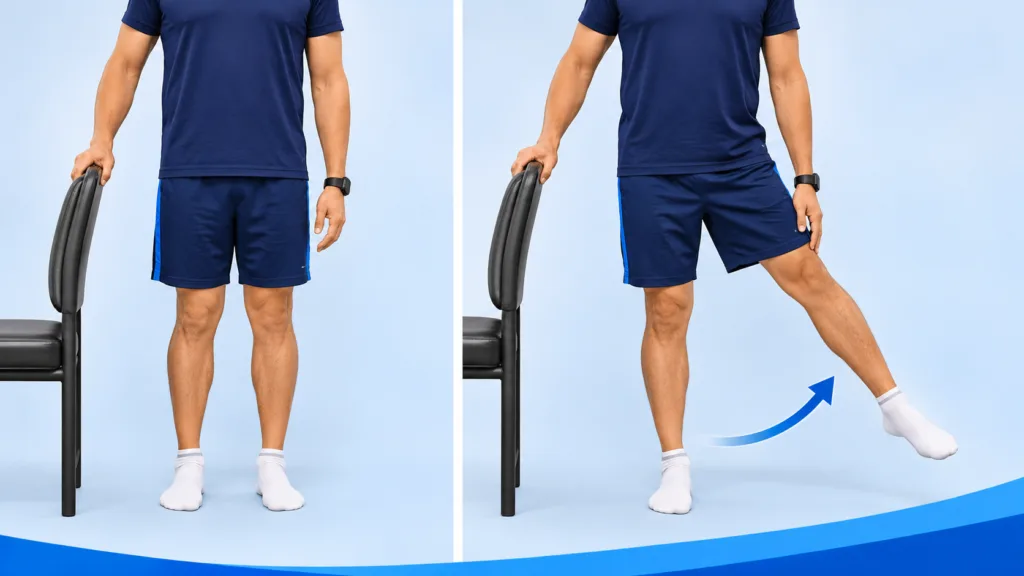
This exercise strengthens the hip muscles that support balance.
How to perform:
- Stand upright while holding a stable surface.
- Move your operated leg sideways without leaning.
- Keep your knee straight.
- Slowly return to the starting position.
3. Light resistance exercises
Once you have good muscle control, your physiotherapist may add light ankle weights or resistance bands to selected exercises.
Resistance exercises often begin around weeks 4–6, although the timing varies.
For example, light resistance may be added to seated knee extensions or hip-strengthening exercises.
The resistance should be increased gradually. Avoid using heavy weights simply because you have reached a particular week of recovery.
4. Stationary cycling
Stationary cycling can help improve knee movement, muscle strength, and endurance.
How to perform:
- Adjust the seat so your knee is nearly straight when the pedal is lowest.
- Begin with gentle backward pedalling.
- Perform partial rotations if full rotations are difficult.
- Progress to full rotations when comfortable.
Your physiotherapist may gradually increase the duration and resistance as your strength and movement improve.
Week 7–8: Balance and walking endurance
Goal: Improve stability, muscle control, and walking confidence.
Continue strengthening exercises while adding more challenging balance and functional movements.
1. Supported single-leg standing
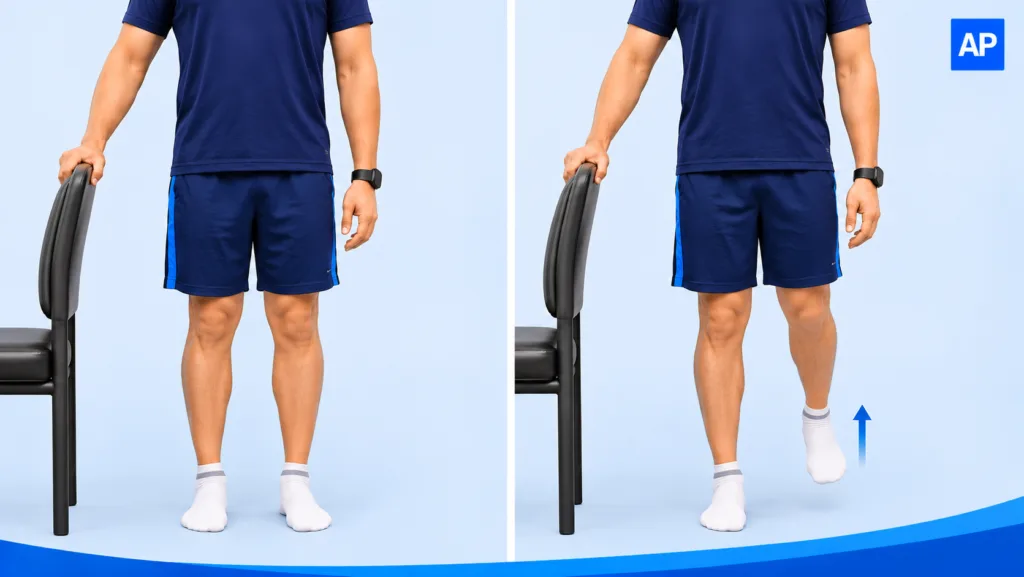
This exercise improves balance and helps your operated leg support your body weight.
How to perform:
- Stand near a stable support.
- Shift your weight onto your operated leg.
- Lift your other foot slightly if safe.
- Hold briefly before lowering it.
Keep support within reach to prevent falls.
2. Side-stepping
Side-stepping strengthens the hip muscles and improves control when moving sideways.
How to perform:
- Stand beside a stable counter.
- Take a small step sideways.
- Bring your other foot towards it.
- Continue for a few steps, then return.
Keep your body upright and movements controlled.
3. Progressive step training
As strength improves, your physiotherapist may introduce slightly higher step-ups or controlled step-downs.
These exercises help improve stair-climbing ability.
4. Walking progression
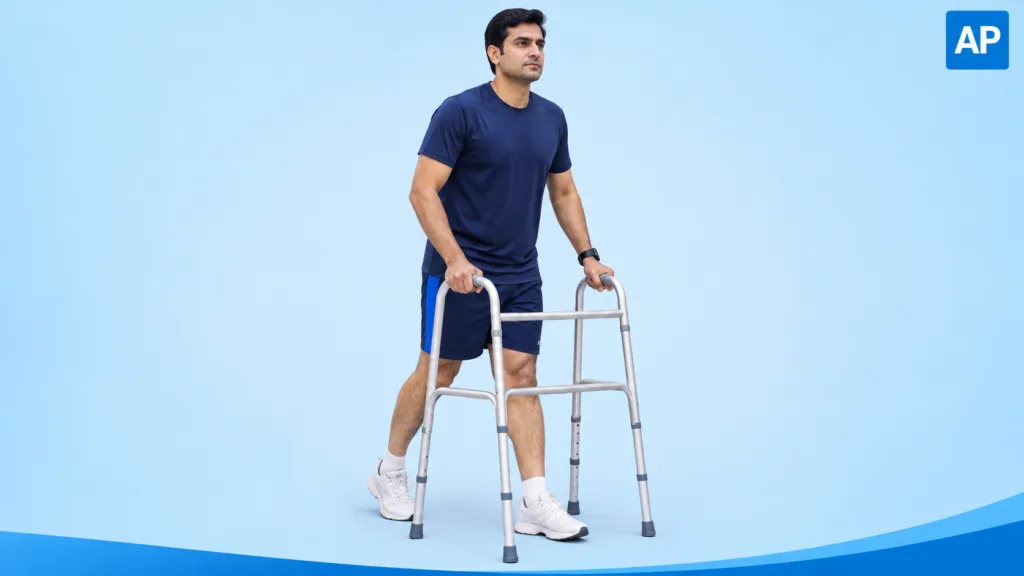
Gradually increase your walking distance while maintaining an even walking pattern.
Some patients can walk without support by this stage, while others still need a cane or walker.
Do not stop using your walking aid until your balance, strength, and walking control are adequate.
Week 9–12: Advanced strengthening and daily activities
Goal: Improve endurance, balance, independence, and functional strength.
By this stage, many patients perform daily activities more comfortably. However, strength and movement may continue improving for several months.
1. Progressive squats
Continue supported squats, gradually increasing the depth as your strength and comfort allow.
Avoid deep squats unless your rehabilitation team approves them.
2. Advanced step exercises
Higher step-ups and controlled step-downs may be introduced as your strength improves. These exercises prepare your knee for climbing stairs more confidently.
Always use a handrail or support when needed.
3. Resistance training
Your physiotherapist may gradually increase resistance during quadriceps, hamstring, and hip-strengthening exercises.
Resistance bands, ankle weights, or suitable gym equipment may be used.
The aim is to improve strength while maintaining proper movement control.
4. Balance training

Balance exercises may become more challenging as your stability improves.
Examples include standing with a narrower foot position, changing direction while walking, or performing supervised balance exercises on different surfaces.
The level of difficulty should match your balance and fall risk.
5. Walking and cycling
Walking and stationary cycling can help improve stamina.Gradually increase activity duration according to your comfort and your knee’s response.
You should be able to exercise without developing significant pain, swelling, or worsening of your walking pattern.
After knee replacement: Two critical exercises
When patients ask about the two most critical exercises after knee replacement, I emphasize knee bending and knee straightening.
1. Heel Slides for Knee Bending
Heel slides improve knee flexion, which is needed for sitting, climbing stairs, and getting into a car.
You can begin gentle heel slides early after surgery (under supervision only) and continue them as long as your knee bending needs improvement.
2. Knee Straightening Exercises
Knee extension exercises help restore the ability to straighten your leg.
This movement is important for standing and walking without excessive effort.
Quadriceps sets also help by strengthening the muscles responsible for straightening the knee.
Both bending and straightening should be addressed during rehabilitation. Improving one movement while neglecting the other can affect your overall knee function.
What is the best exercise for a stiff knee after surgery?
Heel slides and seated knee bends help improve knee bending, while quadriceps sets and gentle knee straightening stretches help you straighten your knee. The best exercise depends on which movement is difficult for you.
Knee stiffness is common in the first few weeks after surgery. It can happen due to pain, swelling, and healing tissues. Stationary cycling may also help reduce stiffness once you can bend your knee enough to pedal safely.
The goal is to slowly improve how far your knee can bend and straighten.
Do not force your knee to move through severe pain. If stiffness gets worse or does not improve as expected, consult your surgeon or physiotherapist.
How often should you exercise after knee replacement?
You may need to exercise several times a day after knee replacement, depending on your recovery and your physiotherapist’s advice. Short sessions throughout the day are often easier to manage, especially in the first few weeks.
The American Academy of Orthopaedic Surgeons (AAOS) suggests exercise sessions of around 20–30 minutes, but the duration and frequency may vary based on your pain, swelling, and progress.
Here is how your exercise routine may change over the first 12 weeks:
| Recovery period | Main focus |
| Weeks 1–2 | Knee movement, muscle activation, circulation, and assisted walking |
| Weeks 3–4 | Improving knee flexibility, basic strengthening, and functional movements |
| Weeks 5–6 | Progressive resistance, step training, and stationary cycling |
| Weeks 7–8 | Balance, muscle control, and walking endurance |
| Weeks 9–12 | Advanced strengthening, balance, and daily activities |
These stages can overlap. You should not stop useful exercises simply because you have moved into the next phase.
Mild stretching discomfort may occur during rehabilitation. However, severe pain, increasing swelling, or persistent worsening of symptoms may mean that the exercise is too difficult.
Which exercises should you avoid after knee replacement?
You should avoid running, jumping, deep squats, and sudden twisting movements during early recovery of knee replacement. These activities can put too much stress on your healing knee or increase your risk of falling.
I also recommend avoiding:
- Heavy weights: Do not lift heavy weights until your surgeon or physiotherapist says it is safe.
- Forceful knee bending: Do not push your knee beyond what you can comfortably manage.
- Unsupported balance exercises: Avoid standing on one leg without support if you feel unsteady.
These limits may change as your knee gets stronger. Your surgeon or physiotherapist will guide you on when it is safe to try more challenging exercises.
Can you do knee replacement exercises at home?
Yes, you can do many knee replacement exercises at home once your physiotherapist has taught you how to perform them safely. Regular home exercises help improve knee movement and muscle strength after you leave the hospital.
Research shows that home exercises can work as well as clinic-based physiotherapy for many patients. However, you may need a physiotherapist’s help if your knee is very stiff, your muscles are weak, or you have trouble walking or keeping your balance.
You can also use a total knee replacement exercises PDF from AAOS to understand the exercises and follow the instructions.
However, I recommend regular follow-ups with your physiotherapist to check your progress and decide when to move on to more challenging exercises.
When should you contact your doctor?
Contact your doctor if you notice increasing pain, swelling, redness, or other unusual symptoms after knee replacement. Mild pain and swelling are common during recovery, but some warning signs need medical attention.
Contact your surgical team if you have:
- Knee pain or swelling that gets worse instead of better.
- Increasing redness or warmth around the knee.
- Fever or fluid leaking from the wound.
- New pain or swelling in your calf.
- Severe stiffness or sudden difficulty moving your knee.
Seek emergency medical care if you have sudden breathing difficulty, chest pain, or fainting. These may be signs of a serious problem, such as a blood clot in the lungs.
Stop exercising if you feel severe or unusual pain, and seek medical advice.
Why is physiotherapy important after knee replacement?
Physiotherapy after knee replacement helps you regain knee movement, build muscle strength, improve balance, and walk safely. It also helps your physiotherapist check your progress and adjust exercises as your knee heals.
For example, if you cannot straighten your knee fully, you may need more stretching exercises. If you find climbing stairs difficult, you may need exercises to strengthen your thigh muscles.
I recommend continuing your home exercises and attending physiotherapy sessions as advised. Supervised physiotherapy is especially helpful if you have severe stiffness, weak muscles, poor balance, or trouble walking.
If you need help with recovery, visit our physiotherapy clinic in Kharadi for guidance.
Frequently asked questions
1. When should I start exercises after knee replacement?
Gentle exercises usually begin on the day of surgery or the next day. Your physiotherapist will guide you through ankle pumps, thigh muscle exercises, and gentle knee bending.
2. Can I perform straight leg raises during the first week?
Yes, you may start straight leg raises during the first week if you can keep your knee straight while lifting your leg under Physiotherapist’s guidance and supervision only. If you find this difficult, your physiotherapist may help you perform the exercise.
3. How much should my knee bend after two weeks?
There is no single target for everyone. How much your knee bends depends on swelling, pain, and how well your knee moved before surgery. Your physiotherapist will check your progress and guide you.
4. Is pain normal during knee bending exercises?
Mild pain or a stretching feeling can be normal. However, you should not force your knee through sharp or severe pain. Stop or reduce the exercise and speak to your physiotherapist if pain or swelling gets worse.
5. When can I start stationary cycling?
You can start when your knee bends enough to pedal safely and your physiotherapist approves. You may begin with small forward and backward pedal movements before trying full rotations.
6. How long should I continue exercising?
You may need to continue exercises for several months after surgery. Knee strength and movement can keep improving beyond 12 weeks. Your physiotherapist will help you plan exercises based on your recovery.
Final thoughts
Exercises after knee replacement help you regain knee movement, build strength, and return to daily activities. You will usually start with gentle movements and slowly progress to walking, cycling, strengthening, and balance exercises.
Your recovery should guide when you move to harder exercises, not just the number of weeks since surgery. I recommend following your home exercise plan and seeking help from your physiotherapist if you have pain, stiffness, or difficulty making progress.
If you need help with exercises after knee replacement, visit our physiotherapy clinic in Kharadi for guidance and support during your recovery.