Revision knee replacement
Revision knee replacement in Pune
Revision knee replacement treats problems with an existing knee replacement, including loosening, infection, instability, wear or fracture. The operation depends on what has failed and which components need to be changed.
Dr. Aniket Patil · Knee replacement and revision surgeon · Kharadi, Pune
- 20+ years
- Clinical & surgical experience
- 3,000+
- Joint replacement surgeries
- Germany
- Joint replacement fellowship training
Medically reviewed by Dr. Aniket Patil, MS Orthopaedics
Overview
What is revision knee replacement?
Revision knee replacement is surgery to repair or replace part or all of an existing knee replacement when the implant or surrounding joint has developed a problem.
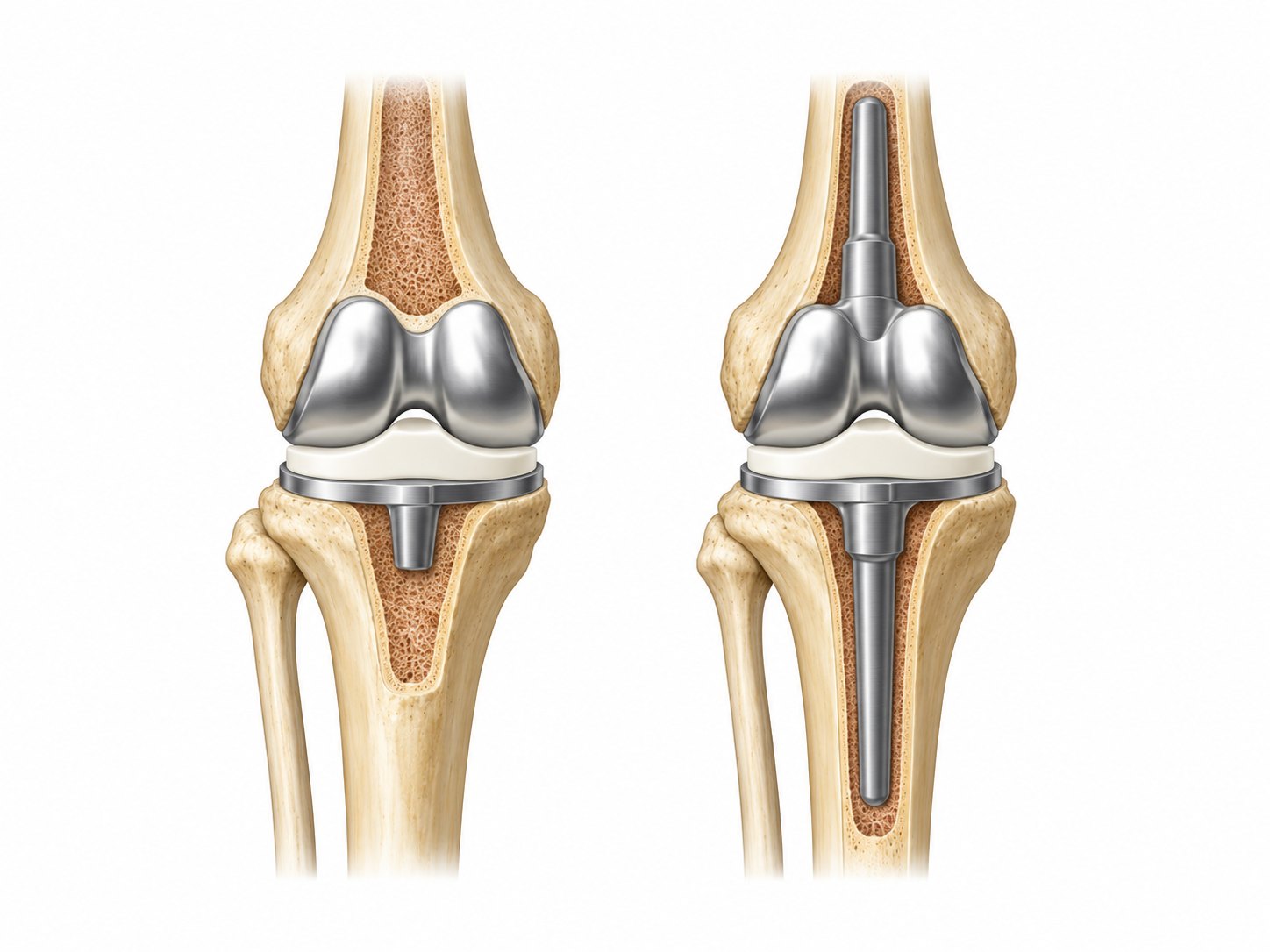
Some revisions involve changing one component. Others require removal of the whole implant and reconstruction of lost bone with revision components, stems, augments or bone graft.
Because the previous implant has to be assessed and sometimes removed, revision surgery is usually more complex than the first knee replacement.
Learn about total knee replacementWhy might a knee replacement need revision?
-
Loosening or wear
The implant can loosen from the bone or the plastic bearing can wear, causing pain, swelling or instability.
-
Infection
Infection around the implant can cause pain, swelling, wound problems or loosening, sometimes long after the original operation.
-
Instability
The knee can feel loose or give way if implant position, ligament support or soft-tissue balance is no longer adequate.
-
Stiffness
Scar tissue or component position can restrict bending or straightening enough to interfere with daily life.
-
Fracture around the implant
A fracture can damage the bone supporting the replacement or loosen the components.
Pain after knee replacement has several possible causes. Identifying the cause is the first step because each problem requires a different treatment.
How is the cause of pain after knee replacement diagnosed?
Dr. Aniket Patil starts with the symptoms, examination and current X-rays, then adds infection tests or CT when more information is needed.
History and examination
When the symptoms began, where the pain is felt and how the knee moves and bears weight help narrow down the cause. He also checks whether pain could be coming from the hip or spine.
X-rays
Current and previous X-rays can show loosening, wear, fracture, changes in component position and bone loss.
Infection tests
Blood tests and, when needed, joint-fluid testing help determine whether infection is present.
CT
CT can show component position, bone loss or fracture in more detail when X-rays do not show enough detail.
What happens during revision knee replacement?
The operation is planned around the specific reason the knee replacement has failed.
-
Remove what has failed
Dr. Aniket Patil removes the components or cement that need to be replaced, together with any damaged tissue that needs to be cleared.
-
Assess the remaining bone and ligaments
He checks how much healthy bone remains and whether the ligaments can still stabilise the knee.
-
Rebuild lost support
Bone loss may require metal augments, bone graft or longer stems to create secure support for the revision implant.
-
Position the revision components
The new components are positioned to restore fixation, alignment and stability.
-
Check the knee
Movement and stability are checked before the wound is closed.
What if infection is causing the knee replacement to fail?
Infection changes the revision strategy, so it needs to be confirmed or ruled out before the operation is planned.
Some infections can be treated by cleaning the joint and exchanging the plastic insert while retaining well-fixed components. Others require removal of the implants and a staged revision, with an antibiotic spacer before the new replacement is inserted.
Dr. Aniket Patil bases the plan on when the infection started, the test results, the condition of the tissues and whether the existing components remain secure.
How do I prepare for revision knee replacement?
-
Medical assessment
Revision surgery can be longer and more complex than a first knee replacement, so medical and anaesthetic assessment is important.
-
Previous surgery records
Bring operation notes, implant details, old X-rays, scans and discharge summaries if you have them.
-
Infection investigations
Bring previous blood tests, joint-fluid results and microbiology reports if infection has been investigated.
-
Home and recovery planning
Arrange walking aids and help at home. Recovery can take longer than after the original replacement.
What is recovery like after revision knee replacement?
Recovery depends on how extensive the revision is, whether bone has been rebuilt and whether weight bearing needs to be restricted.
-
In hospital
Pain control, medical monitoring and physiotherapy begin after surgery.
-
Weight bearing
Some patients can put full weight through the leg early. Others need temporary restrictions while reconstructed bone or graft heals.
-
The first few weeks
Wound healing, swelling control, knee movement and safe walking are the main priorities.
-
The following months
Strength and function improve with rehabilitation. Complex revisions often take longer to recover from than a first knee replacement.
What are the risks of revision knee replacement?
Infection
Revision surgery carries a risk of infection, and previous infection makes treatment more complex.
Blood clots
Preventive treatment and early walking help reduce the risk.
Persistent pain or stiffness
Some patients continue to have pain or restricted movement after revision.
Fracture or bone damage
Bone weakened around an old implant can fracture during or after surgery.
Further implant problems
A revision implant can later loosen, wear or become unstable and may require further surgery.
Dr. Aniket Patil discusses your individual risk after reviewing why the knee failed, the condition of the bone, previous surgery and your general health.
How much does revision knee replacement cost in Pune?
Revision knee replacement cost depends on how much of the implant needs to be changed, the revision components required and whether bone reconstruction is needed.
Hospital, room category and additional medical care also affect the total. A useful estimate can be given once the imaging and revision plan are clear.
Knee replacement surgery cost in PuneWill health insurance cover revision knee replacement?
Yes. Many health insurance policies cover medically necessary joint replacement surgery, subject to the terms of the policy.
Cashless treatment depends on the hospital network, insurer approval and pre-authorisation. Waiting periods, co-pay, room limits and implant limits can affect what is covered.
What affects your coverage
- Waiting period
- Hospital network
- Co-pay
- Room limits
- Implant limits
- Pre-authorisation
Common health insurance providers
- HDFC ERGO
- Niva Bupa
- Care Health Insurance
- Bajaj General Insurance
- Aditya Birla Health Insurance
- Tata AIG
- Digit
- Generali Central Insurance
- Cholamandalam MS
- ACKO
Insurance coverage and cashless eligibility depend on your policy, hospital network and insurer approval.
Been told your knee replacement needs revision?
Dr. Aniket Patil can review why the knee is painful or failing and whether revision surgery can correct the problem.
What has failed, does it need surgery and what needs to be revised?
He reviews the implant, checks for infection, looks at the surrounding bone and determines whether any components can safely remain.
Bring current and previous X-rays, surgery records, implant details and any infection test results.
Get a knee replacement second opinion
Your surgeon
Dr. Aniket Patil
Knee & hip replacement surgeon · Pune
Dr. Aniket Patil focuses on knee and hip replacement and has more than 20 years of clinical and surgical experience. He completed joint replacement fellowship training under Prof. Dr. Klaus-Peter Günther at Carl Gustav Carus University Hospital in Dresden, Germany.
Revision knee replacement begins with diagnosis. Dr. Aniket Patil first establishes why the existing replacement has failed, then plans which components need to change and how lost bone or stability will be restored.
Revision knee replacement FAQs
New or worsening pain, swelling, stiffness, instability or difficulty walking should be assessed. X-rays and other tests are needed to identify the cause.
No. Revision is useful only when the investigation identifies a problem that another operation can correct.
Yes. Some revisions change one component or the plastic insert, while others replace the whole implant.
The investigation can include blood tests and joint-fluid testing together with the examination and X-rays.
Usually. Removing existing components and dealing with scar tissue, bone loss, fracture or infection can make revision more demanding.
It can. Recovery depends on how extensive the surgery is, the condition of the bone and whether weight bearing needs to be restricted.
Yes. Revision implants can later develop infection, loosening, instability or wear.
It depends on the components and reconstruction required, so an accurate estimate follows the revision plan.
A second opinion is particularly useful when the cause of pain is unclear, infection is suspected or more than one revision strategy is possible.
Medical references
- 01American Academy of Orthopaedic Surgeons / OrthoInfo: Revision Total Knee Replacement
- 02American Academy of Orthopaedic Surgeons / OrthoInfo: Total Knee Replacement
- 03American Academy of Orthopaedic Surgeons / OrthoInfo: Infection After Joint Replacement
- 04NHS: Complications of a knee replacement
- 05NHS: Recovering from a knee replacement
Appointments
Find out why your knee replacement is painful
Dr. Aniket Patil can review the implant, check for infection or loosening and explain whether revision surgery can correct the problem.
- Clinic
-
Om Hip & Knee Specialty ClinicUnit No. 202, Second Floor, Velstand
Opposite Reliance Mart, Rakshak Nagar
Kharadi, Pune 411014 Get directions - Hours
- Monday to Saturday
5:00 PM to 10:00 PMBy appointment