Avascular necrosis · AVN
Avascular necrosis (AVN) of the hip: symptoms, diagnosis and treatment
Dr. Aniket Patil assesses your symptoms, risk factors and imaging together to determine the stage of AVN, whether the femoral head has started to collapse and which treatments still make sense.
Dr. Aniket Patil · Knee & hip replacement surgeon · Kharadi, Pune
- 20+ years
- Clinical & surgical experience
- 3,000+
- Joint replacement surgeries
- Germany · Hong Kong
- Fellowship training
Medically reviewed by Dr. Aniket Patil, MS Orthopaedics
Overview
What is avascular necrosis?
Avascular necrosis, or AVN, happens when part of a bone loses enough blood supply that the bone tissue begins to die. Doctors also call it osteonecrosis.
In the hip, AVN most often affects the femoral head, the ball at the top of the thigh bone. Early in the disease, the shape of the hip joint can still look normal. As the damaged bone weakens, small fractures can develop beneath the joint surface.
If the weakened area can no longer support the load passing through the hip, the femoral head can lose its round shape or collapse. Once collapse damages the joint surface, secondary hip arthritis can develop.
The distinction between AVN before collapse and AVN after collapse is central to treatment.
Common symptoms of AVN in the hip
Early AVN can cause few or no symptoms. Pain usually becomes more noticeable as the affected bone weakens.
-
Groin pain
Pain commonly develops deep in the groin and can spread into the thigh or buttock.
-
Pain with weight-bearing
Walking, standing or putting more load through the affected leg can increase pain.
-
Reduced hip movement
The hip can become increasingly stiff as AVN progresses or the joint surface starts to collapse.
-
Limping
Pain and stiffness can change the way you walk and reduce the distance you can comfortably cover.
-
Rest or night pain
More advanced AVN can cause pain even when the hip is not carrying weight and can disturb sleep.
-
Pain in one or both hips
AVN can affect both hips even when one side causes more symptoms than the other.
What happens to the femoral head in AVN?
AVN starts in the bone beneath the cartilage. The joint can therefore look structurally preserved early in the disease even though the bone is already damaged.
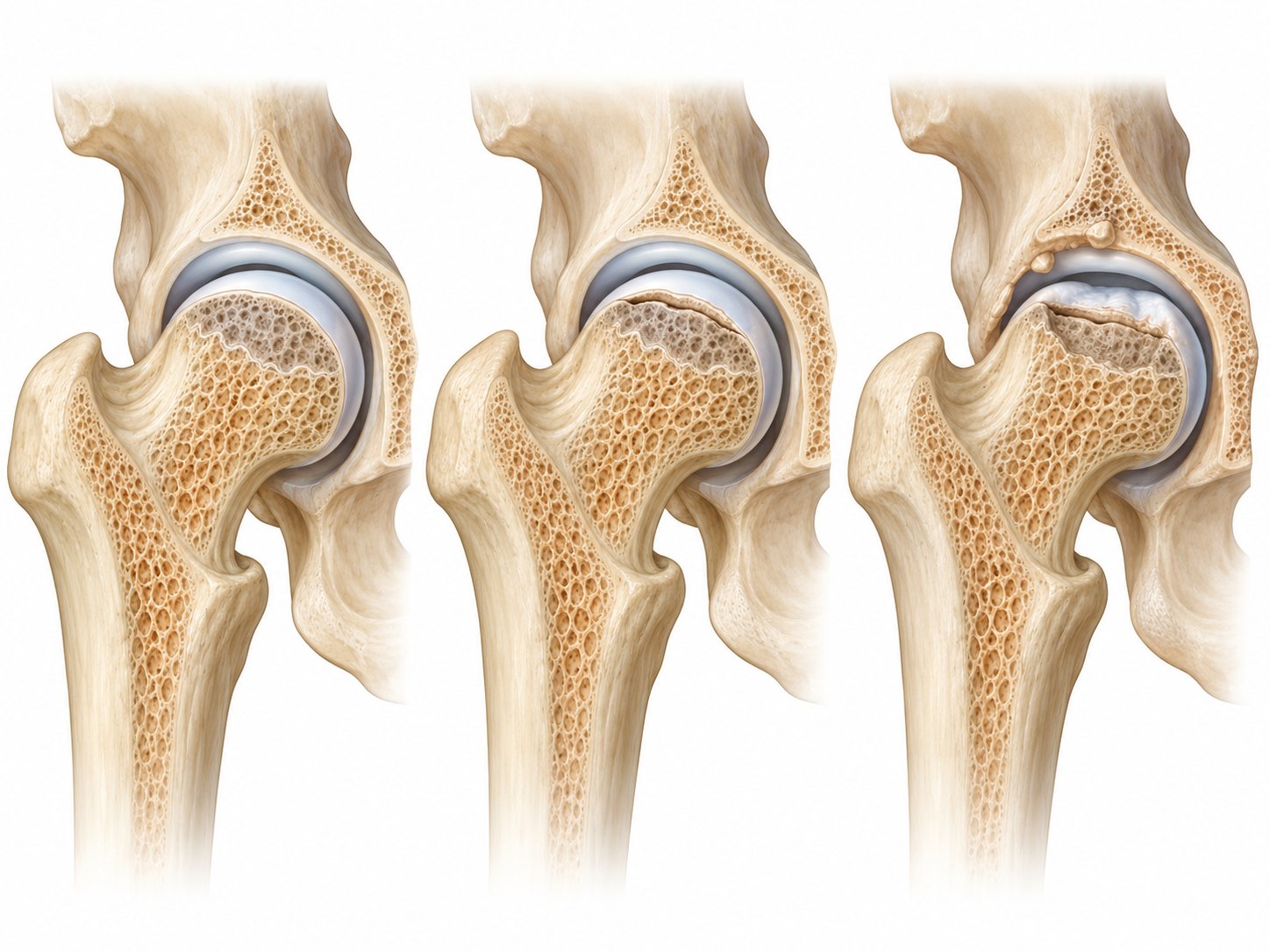
Before collapse
The femoral head can remain round while damaged bone develops beneath the cartilage. Before collapse, treatment may still include options designed to preserve the natural femoral head.
Early collapse
As the weakened bone fails, the surface can start to flatten or develop a subchondral fracture. The mechanics of the hip begin to change.
Advanced collapse
Once the femoral head loses its shape, the damaged surface can wear against the socket and produce secondary arthritis.
What can cause AVN?
AVN can follow an injury or develop without a single obvious cause. A careful medical history helps identify factors that may have reduced blood supply to the bone.
Steroid exposure
Long-term or high-dose corticosteroid treatment is a recognised risk factor for AVN.
Alcohol exposure
Heavy long-term alcohol use is associated with AVN and can affect more than one joint.
Hip injury
A fracture or dislocation can damage blood vessels that supply the femoral head.
Medical conditions and treatment
Some blood disorders, autoimmune conditions, organ transplantation, chemotherapy and radiation treatment are associated with osteonecrosis.
No clear cause
Some people develop AVN without an identifiable cause even after a detailed history.
How does Dr. Aniket Patil assess AVN?
The assessment establishes where the pain is coming from, how much the hip is affected and whether imaging shows AVN before or after collapse.
Symptoms and history
Dr. Aniket Patil asks where the pain occurs, how it has changed and whether there is a history of steroid use, heavy alcohol exposure, hip injury or other recognised risk factors.
Hip examination
He checks movement, pain with rotation, walking and whether the affected hip has become stiff.
Both hips
Because AVN can affect both sides, imaging and symptoms in the opposite hip may also need review.
Stage of the disease
The imaging shows whether the femoral head remains round, whether collapse has begun and whether arthritis has developed.
What do MRI and X-rays show in AVN?
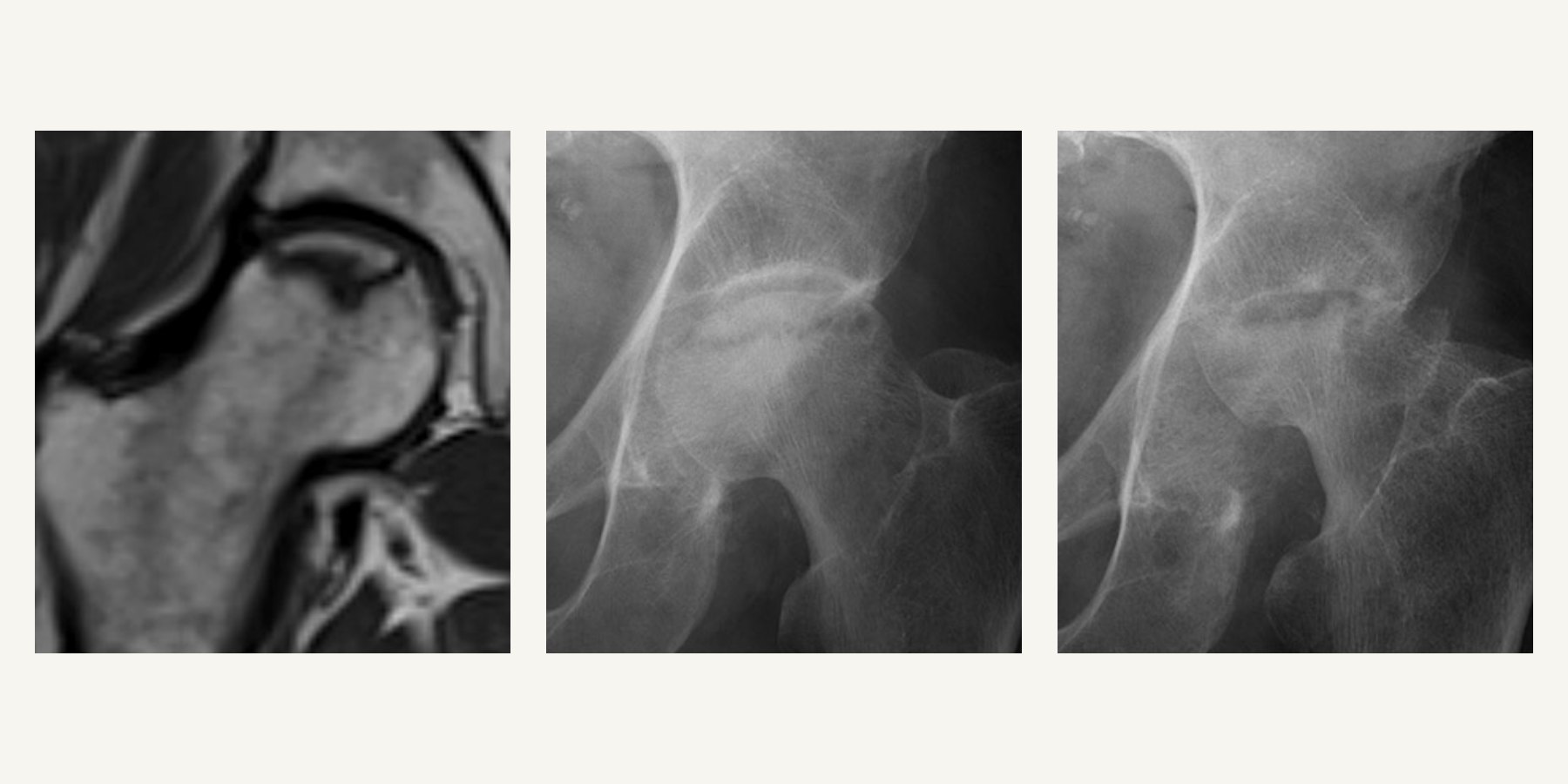
MRI and X-rays answer different questions. MRI can detect AVN before obvious bone changes appear on a standard X-ray, while X-rays become increasingly useful as the structure of the femoral head changes.
-
Early AVN
An X-ray can still look normal in early disease. MRI can show changes inside the femoral head before collapse becomes visible.
-
Collapse begins
X-rays can show a subchondral fracture, flattening or loss of the normal round shape of the femoral head.
-
Secondary arthritis
Advanced disease can narrow the joint space and damage both sides of the hip joint as arthritis develops.
A normal X-ray does not rule out early AVN when the history and symptoms raise concern.
MRI is more sensitive before structural collapse.
How does AVN treatment change by stage?
AVN is not treated the same way at every stage. The most important structural question is whether the femoral head is still preserved or has started to collapse.
-
Before collapse
Reducing load through the hip, managing pain and maintaining useful movement can help control symptoms, but these measures do not reliably restore the damaged bone. The size and location of the AVN lesion, age and stage determine whether a joint-preserving procedure should also be considered.
-
Joint-preserving surgery
Procedures such as core decompression, and in selected cases bone grafting or osteotomy, are designed to preserve the natural femoral head before major collapse. They are not suitable for every case, and their role becomes more limited once the joint surface has failed.
-
After collapse or secondary arthritis
Once the femoral head has lost its shape and the hip causes persistent pain or loss of function, preserving the natural joint becomes less predictable. Once collapse has substantially damaged the joint surface, total hip replacement becomes the main surgical option when pain and loss of function justify surgery.
When does Dr. Aniket Patil recommend hip replacement for AVN?
Dr. Aniket Patil considers hip replacement when AVN has caused femoral-head collapse or secondary arthritis, pain and loss of function are substantial, and preserving the natural joint is unlikely to give a durable result.
The hip is substantially limiting daily life
Pain affects walking, work, sleep or routine activities despite reasonable attempts to manage the symptoms.
The femoral head has lost structural integrity
Imaging shows collapse, deformity or secondary arthritis rather than an early pre-collapse lesion.
The hip is becoming stiff or painful to move
Loss of movement and a painful examination support the structural findings on imaging.
Preserving the natural joint is no longer a durable option
The stage and extent of damage make joint-preserving treatment less likely to provide lasting function.
Age alone does not decide the operation. Dr. Aniket Patil weighs the stage of AVN, the condition of the joint surface, symptoms and daily function together.
Already recommended hip replacement for AVN?
A useful second opinion should clarify the stage of AVN, whether the femoral head has collapsed and whether a realistic joint-preserving option still exists. If replacement is the better option, it should also explain why the timing makes sense.
The key question is not simply ‘Do I have AVN?’ It is ‘What stage is it, and what options remain at this stage?’
Dr. Aniket Patil reviews your existing MRI, X-rays, scans and reports, examines the hip and explains how the imaging changes the treatment decision.
Bring your MRI, X-rays, reports and details of steroid treatment, previous injuries or other relevant medical history if you have them.
Get a hip replacement second opinion
Your surgeon
Dr. Aniket Patil
Knee & hip replacement surgeon · Pune
Dr. Aniket Patil focuses on knee and hip replacement. For AVN of the hip, he reviews the stage of bone damage, whether collapse has occurred, the condition of the joint surface and how much the hip limits daily life. If replacement is indicated, he plans and performs total hip replacement with robotic assistance.
Avascular necrosis FAQs
Common questions about AVN of the hip, imaging and treatment.
Yes. AVN can affect both hips even when only one side is painful. Dr. Aniket Patil may review both hips when the diagnosis or risk factors suggest disease on both sides.
Yes. Early AVN can be present before changes become obvious on a standard X-ray. MRI is more sensitive for detecting early bone changes.
Long-term or high-dose corticosteroid exposure is a recognised risk factor for AVN, but not everyone who receives steroids develops it. The dose, duration and other medical factors all matter.
No. Treatment depends strongly on the stage of AVN. Before collapse, joint-preserving treatment may still have a role. Hip replacement becomes a more realistic option after structural collapse or secondary arthritis causes substantial pain and loss of function.
Core decompression is a joint-preserving operation used mainly in earlier stages of AVN. The surgeon creates channels in the affected bone to reduce pressure and encourage a healing response. It is not suitable for every stage or every AVN lesion.
Yes. If the femoral head collapses and loses its normal shape, the damaged joint surface can wear against the socket and lead to secondary hip arthritis.
Dr. Aniket Patil considers hip replacement when the femoral head has collapsed or secondary arthritis has developed, symptoms substantially limit daily life and preserving the natural joint is unlikely to provide a durable result.
Medical references
Patient information on this page is informed by established medical and orthopaedic guidance.
- 01National Institute of Arthritis and Musculoskeletal and Skin Diseases: Osteonecrosis
- 02National Institute of Arthritis and Musculoskeletal and Skin Diseases: Osteonecrosis: Diagnosis, Treatment, and Steps to Take
- 03Mayo Clinic: Avascular necrosis (osteonecrosis): Symptoms and causes
- 04Mayo Clinic: Avascular necrosis (osteonecrosis): Diagnosis and treatment
- 05Johns Hopkins Medicine: Avascular Necrosis
Appointments
Discuss your AVN diagnosis with Dr. Aniket Patil
If you have hip pain, an AVN diagnosis or an MRI showing osteonecrosis, Dr. Aniket Patil can review the imaging, assess the stage of the disease and explain which treatment options still make sense.
- Clinic
-
Om Hip & Knee Specialty ClinicUnit No. 202, Second Floor, Velstand
Opposite Reliance Mart, Rakshak Nagar
Kharadi, Pune 411014 Get directions - Hours
- Monday to Saturday
5:00 PM to 10:00 PMBy appointment