Total knee replacement
Total knee replacement in Pune
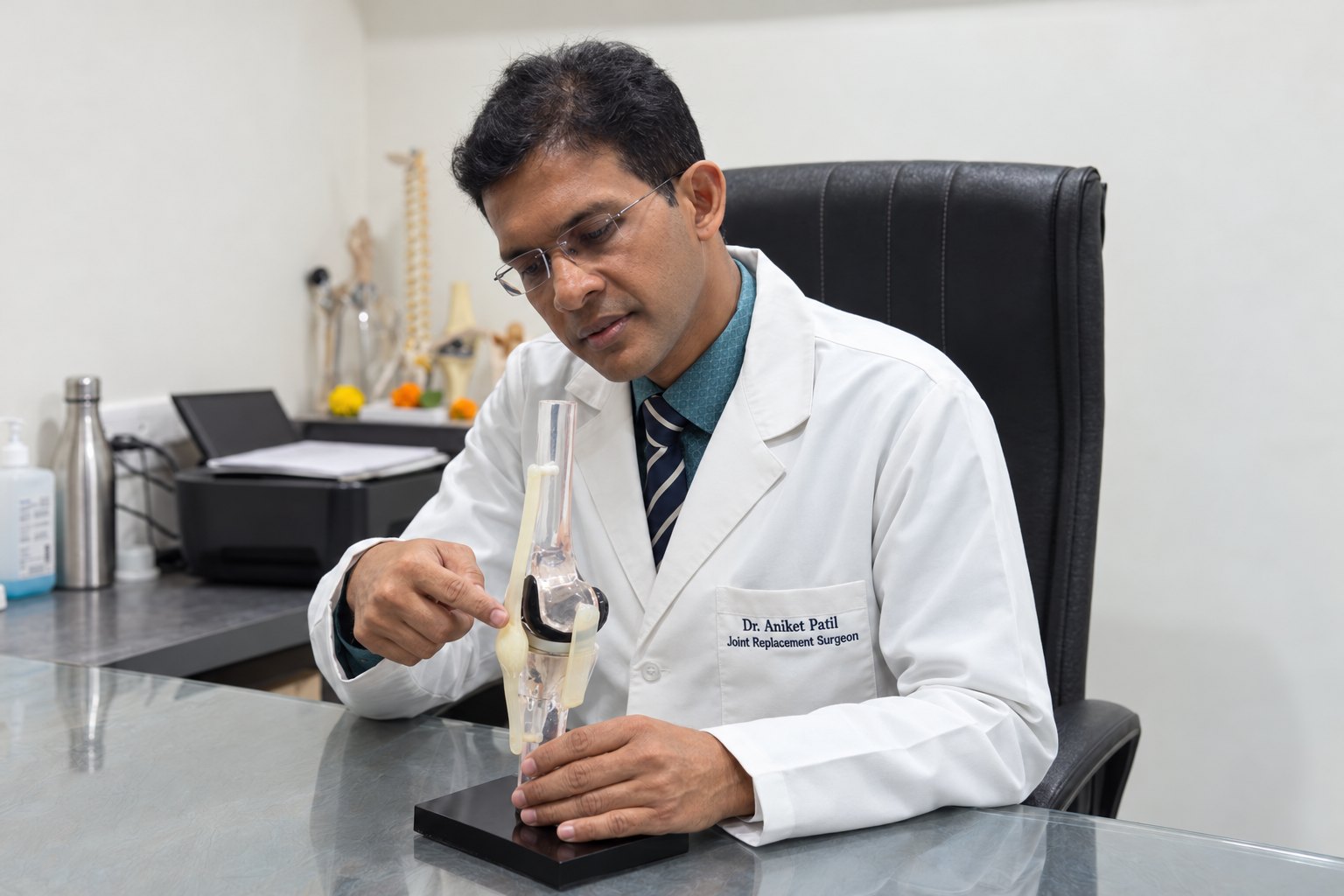
Total knee replacement can reduce pain and improve movement when advanced knee arthritis is limiting daily life and non-surgical treatment no longer gives enough relief. Dr. Aniket Patil performs both robotic-assisted and conventional knee replacement in Pune.
Knee & hip replacement surgeon · Kharadi, Pune
- 20+ years
- Clinical & surgical experience
- 3,000+
- Joint replacement surgeries
- Germany
- Joint replacement fellowship training
Medically reviewed by Dr. Aniket Patil, MS Orthopaedics
Overview
What is total knee replacement?
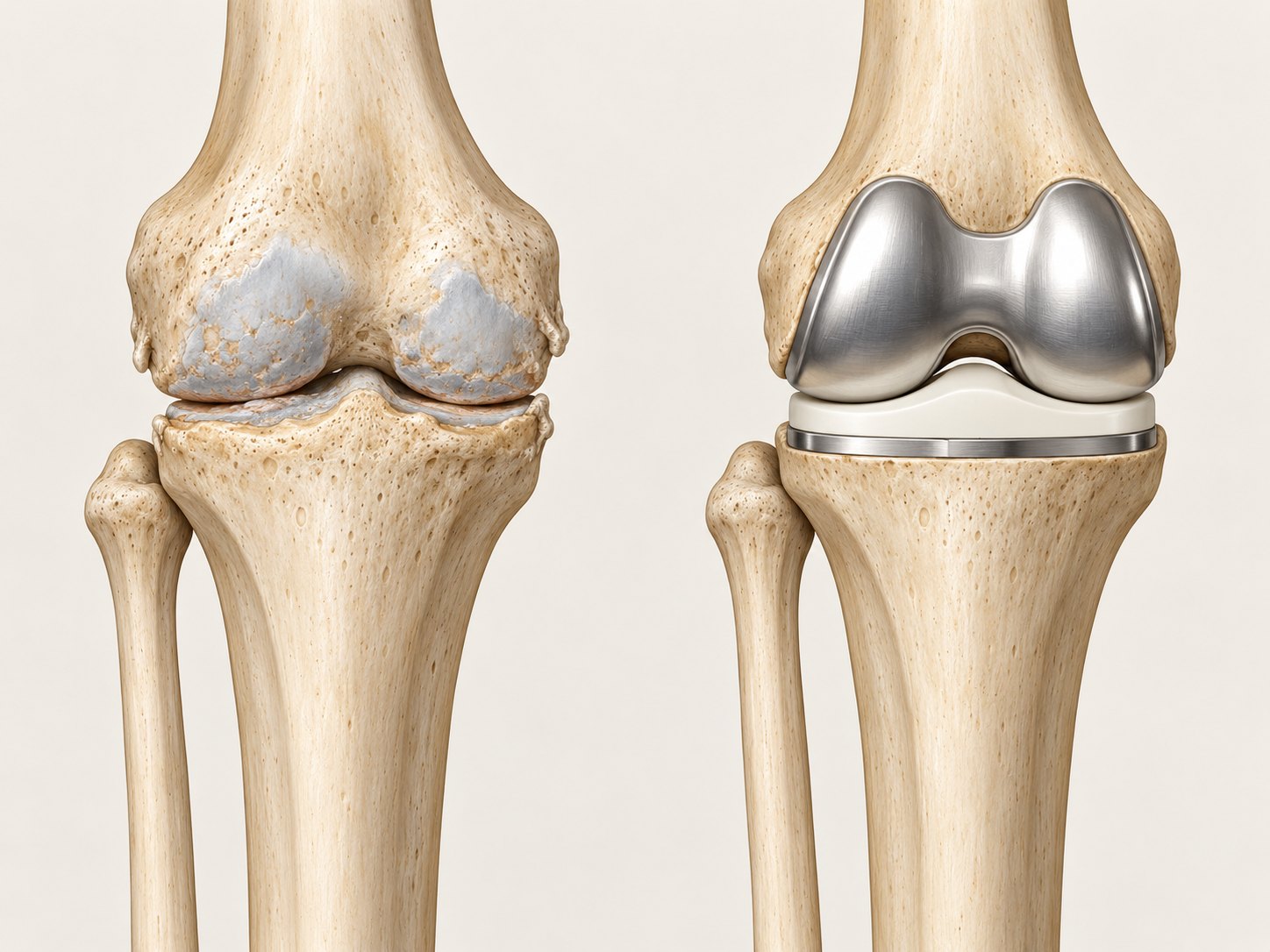
Total knee replacement replaces the worn joint surfaces at the ends of the thigh bone and shin bone with metal implants. A medical-grade plastic spacer sits between them to create the new bearing surface.
The operation does not remove the whole knee. It replaces the damaged joint surfaces while preserving the muscles and other soft tissues around the knee.
Read about knee arthritisWhen does Dr. Aniket Patil recommend total knee replacement?
He considers total knee replacement when pain and stiffness are seriously limiting daily life, non-surgical treatment no longer gives enough relief, and the examination and X-rays confirm widespread arthritis.
Pain and stiffness limit daily life
Walking, stairs, sleep, work or routine activities have become difficult.
Other treatment is no longer enough
Physiotherapy, exercise, medication, activity changes or injections are no longer giving enough relief.
The examination confirms the problem
Dr. Aniket Patil checks knee movement, stability, deformity, walking and where the pain is coming from.
X-rays show widespread arthritis
Total replacement is more likely to be needed when arthritis affects several parts of the knee rather than one compartment alone.
The recommendation combines your symptoms and function, the knee examination, X-rays and how much previous treatment has helped.
Total or partial knee replacement?
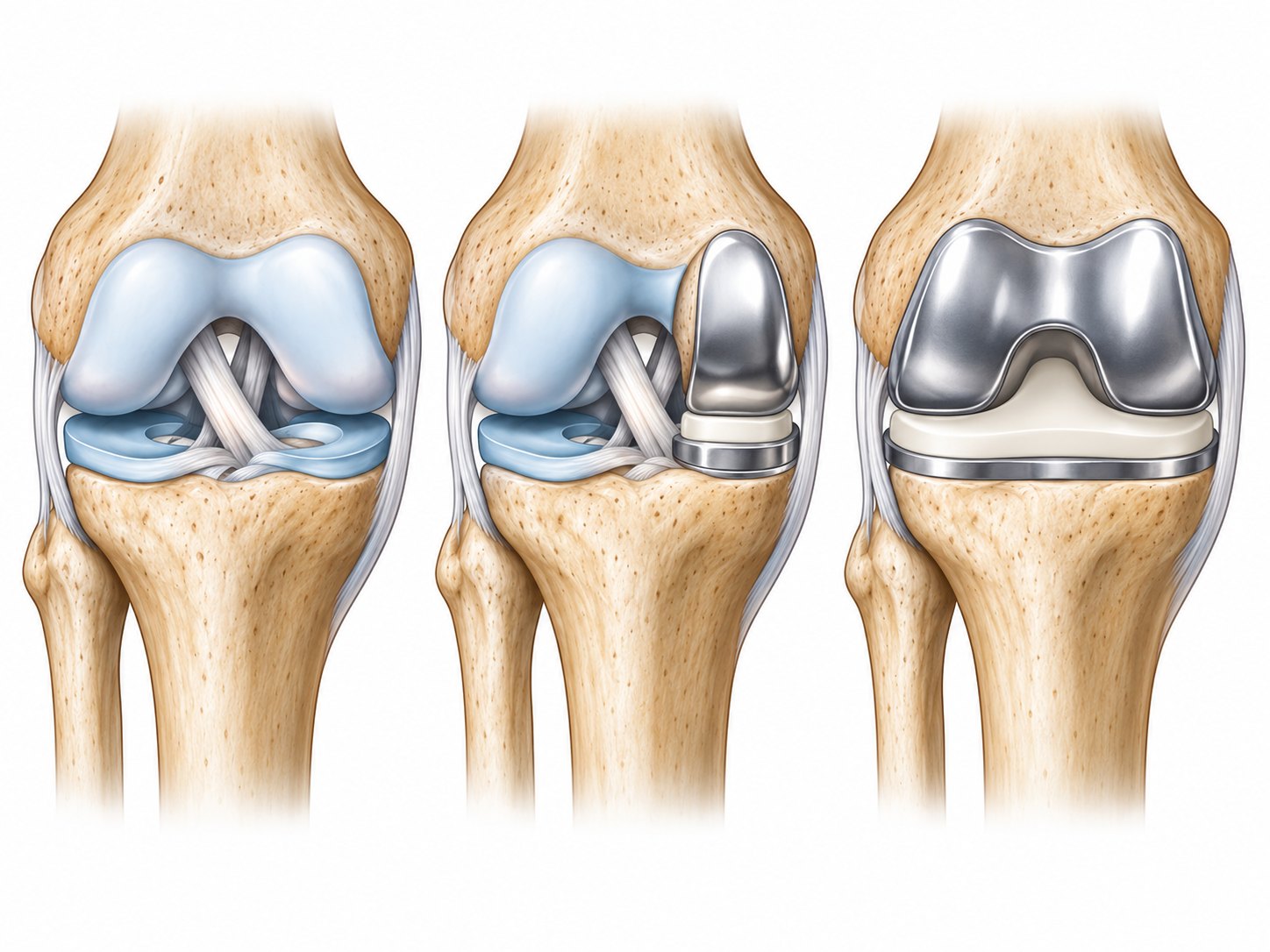
Total knee replacement treats arthritis affecting several parts of the knee. Partial knee replacement preserves the healthy parts when damage is limited to one compartment. Dr. Aniket Patil uses the X-rays, examination and condition of the ligaments to decide which option fits the knee.
Several parts of the knee
Total knee replacement
Total knee replacement is usually the better option when arthritis is widespread and replacing only one compartment would leave significant damage untreated.
One compartment
Partial knee replacement
Partial knee replacement may suit arthritis limited to one compartment when the remaining compartments and ligaments are healthy enough to preserve.
Learn about partial knee replacement- Both knees have significant arthritis? Learn about bilateral knee replacement
- Problems with a previous knee replacement? Learn about revision knee replacement
How does robotic knee replacement work?
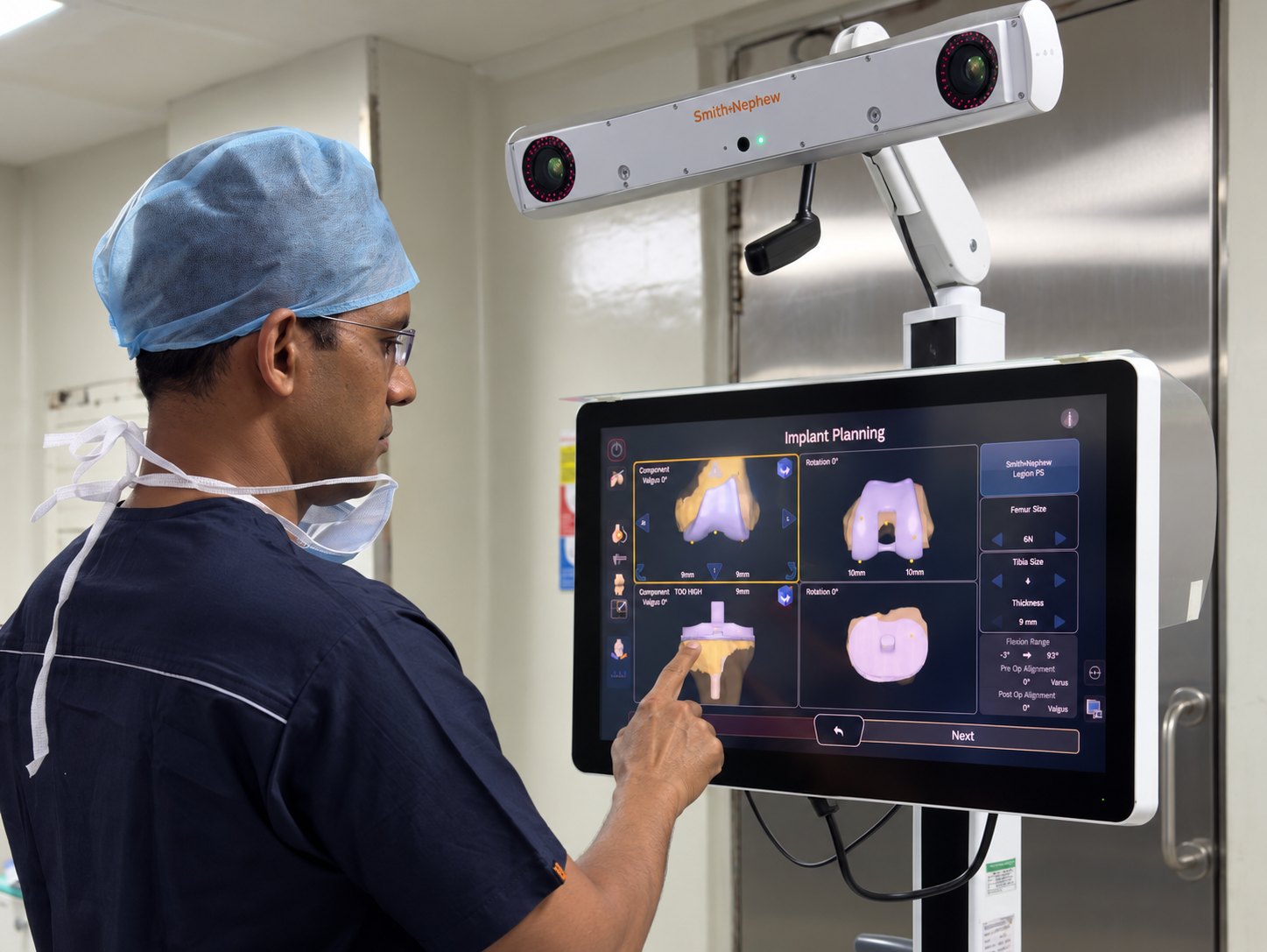
Robotic assistance helps Dr. Aniket Patil create a 3D plan for implant size, position and alignment, then reproduce that plan during surgery.
The system assists with planning and execution; Dr. Aniket Patil remains in control of the operation throughout.
-
Map the knee
The system creates a 3D model from pre-operative imaging or mapping during surgery, showing the knee anatomy and alignment.
-
Plan the replacement
He uses the model to plan implant size, position and alignment before the final bone preparation.
-
Carry out the plan
During surgery, robotic assistance helps him reproduce the planned bone preparation and implant position.
Not every knee requires robotic assistance. Dr. Aniket Patil also performs conventional knee replacement and chooses the technique according to the knee and surgical plan.
What happens during total knee replacement?
Dr. Aniket Patil performs total knee replacement in five main stages.
-
Anaesthesia and preparation
The anaesthesia team prepares and monitors you. The surgical team cleans and positions the knee.
-
Remove the damaged surfaces
He removes the damaged cartilage and a small amount of bone from the ends of the thigh bone and shin bone.
-
Prepare and balance the knee
He prepares the bone for the implants and checks alignment, movement, stability and soft-tissue balance.
-
Place the implants
Metal components cover the prepared bone surfaces and a medical-grade plastic spacer sits between them. The underside of the kneecap may also be resurfaced when needed.
-
Final checks and closure
He checks knee movement and stability before closing the wound.
How do I prepare for total knee replacement?
Before surgery, the team checks your medical fitness, reviews your medicines and helps you prepare for admission and recovery at home.
-
Medical assessment
You may need blood tests, an ECG or other tests depending on your age, health and anaesthesia plan. Conditions such as diabetes, heart disease or high blood pressure should be well controlled before surgery.
-
Medicines
Tell the team about all prescription medicines, blood thinners, diabetes medicines and supplements. You will be told which to continue and which to stop.
-
Home and support
Plan transport home, help with daily tasks in the early weeks and a safe space to walk and exercise. Arrange any walking aid the physiotherapy team advises.
-
Admission
Follow the hospital’s fasting and admission instructions. Bring your reports, scans, medicine list and insurance documents.
What is recovery like after total knee replacement?
Most patients stand and begin walking soon after surgery. Movement, strength and confidence then improve over the following weeks and months.
-
In hospital
The team controls pain and starts movement early. A physiotherapist helps you walk with a frame, crutches or another aid.
-
The first few weeks
The priorities are wound healing, reducing swelling, regaining knee movement and gradually walking further. Many patients still use a walking aid during this period.
-
Returning to everyday activities
Walking, stairs and routine activities improve as strength and balance return. Driving, work and more demanding activity depend on your progress and the type of activity.
-
The following months
Swelling settles and strength and movement continue to improve. Recovery varies from person to person.
What are the risks of total knee replacement?
Total knee replacement is a major operation and has recognised risks.
Infection
Infection can affect the wound or the deeper tissues around the implant. A deep infection may require further surgery.
Blood clots
A blood clot can form in the leg after surgery and, less commonly, travel to the lungs. Early walking and prescribed preventive treatment help reduce the risk.
Stiffness or persistent pain
Some patients continue to have stiffness, restricted movement or pain after recovery and may need further assessment or treatment.
Instability, wear or loosening
A knee replacement can develop mechanical problems over time. Significant wear, loosening or instability may eventually require revision surgery.
Nerve, blood-vessel or bone injury
Nerve or blood-vessel injury and fracture around the knee are uncommon but recognised complications of surgery.
Dr. Aniket Patil reviews your individual risk before surgery based on your general health, knee deformity, previous operations and other medical factors.
How much does robotic knee replacement cost in Pune?
Robotic knee replacement cost in Pune depends on the implant, hospital, room category, robotic surgery charges and any additional medical care you need.
For a more accurate estimate, the knee first needs to be examined and the operation confirmed.
Knee replacement surgery cost in PuneWill health insurance cover knee replacement surgery?
Yes. Many health insurance policies cover knee replacement surgery, subject to your policy terms.
Cashless treatment depends on the hospital network, your insurer and pre-authorisation. Your coverage can also be affected by waiting periods, co-pay, room limits and implant limits.
What affects your coverage
- Waiting period
- Hospital network
- Co-pay
- Room limits
- Implant limits
- Pre-authorisation
Common health insurance providers
- HDFC ERGO
- Niva Bupa
- Care Health Insurance
- Bajaj General Insurance
- Aditya Birla Health Insurance
- Tata AIG
- Digit
- Generali Central Insurance
- Cholamandalam MS
- ACKO
Insurance coverage and cashless eligibility depend on your policy, hospital network and insurer approval.
Already recommended knee replacement?
If another surgeon has advised knee replacement, Dr. Aniket Patil can review whether surgery is needed now, whether total or partial replacement is right and whether he agrees with the proposed plan.
Which operation, why this operation and why now?
He reviews your X-rays, knee movement, symptoms and previous treatment, then explains what he recommends and why.
Bring your X-rays, scans, reports and details of the treatment you have already tried.
Get a knee replacement second opinion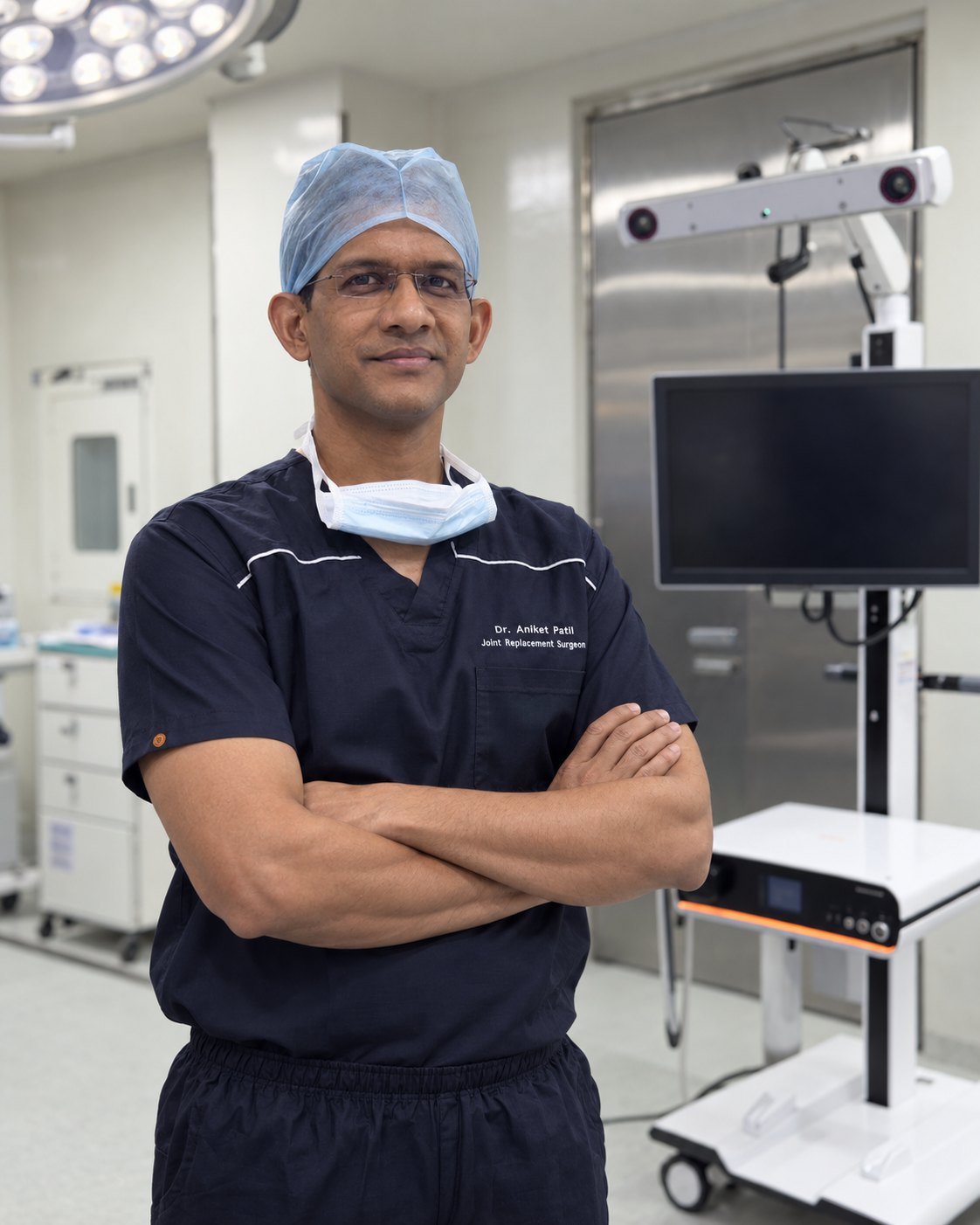
Your surgeon
Dr. Aniket Patil
Knee & hip replacement surgeon · Pune
Dr. Aniket Patil focuses on knee and hip replacement and has more than 20 years of clinical and surgical experience. He completed joint replacement fellowship training under Prof. Dr. Klaus-Peter Günther at Carl Gustav Carus University Hospital in Dresden, Germany.
He performs both robotic-assisted and conventional knee replacement and treats total, partial and bilateral knee replacement cases. The surgical approach depends on the pattern of arthritis, knee anatomy and the operation required.
Total knee replacement FAQs
Common questions about robotic knee replacement, surgery and recovery.
Robotic assistance can improve surgical planning and implant-positioning accuracy. Conventional knee replacement remains a well-established option. Dr. Aniket Patil performs both and chooses the technique that suits the surgical plan.
Usually soon after surgery, once you are medically stable, with a frame, crutches or another aid. How quickly you progress depends on pain, strength and balance.
Most patients make substantial progress in the first 6 to 12 weeks, and strength and movement continue to improve for several months. Your age, health and rehabilitation all affect recovery.
Many patients go home within 1 to 3 days, once they are medically stable, pain is controlled and they can walk safely. Some need a longer stay.
Expect pain and swelling, particularly in the first few days. Pain is controlled so you can start moving and physiotherapy safely, and it eases as the knee heals.
Most last at least 15 years. The American Academy of Orthopaedic Surgeons reports that more than 90% of modern total knee replacements are still functioning well 15 years after surgery. How long yours lasts also depends on your age, activity level and weight.
Possibly, if arthritis is limited to one compartment and the rest of the knee is healthy enough to preserve. The X-rays, knee movement and stability show whether partial replacement is suitable.
Yes. Both knees can be replaced in one operation or in two separate operations, depending on each knee and your overall health.
There is no single best age. The decision depends on symptoms, X-rays and overall health rather than age.
It depends on the implant, hospital, room category, robotic surgery charges and your medical needs.
A painful knee replacement needs assessment to find the cause. Loosening, wear, instability, stiffness or infection can sometimes require revision surgery.
Medical references
- 01American Academy of Orthopaedic Surgeons / OrthoInfo: Total Knee Replacement
- 02American Academy of Orthopaedic Surgeons / OrthoInfo: Knee Replacement Implants
- 03American Academy of Orthopaedic Surgeons: Surgical Management of Osteoarthritis of the Knee
- 04NHS: What is a knee replacement?
- 05NHS: Recovering from a knee replacement
- 06NHS: Complications of a knee replacement
- 07Alrajeb et al.: Robotic-assisted versus conventional total knee arthroplasty: systematic review and meta-analysis of randomized controlled trials
- 08American Academy of Orthopaedic Surgeons / OrthoInfo: Robotic-Assisted Joint Replacement
Appointments
Discuss knee replacement with Dr. Aniket Patil
If knee pain and stiffness are limiting daily life, book a consultation to review your X-rays, examine the knee and discuss whether knee replacement is right for you.
- Clinic
-
Om Hip & Knee Specialty ClinicUnit No. 202, Second Floor, Velstand
Opposite Reliance Mart, Rakshak Nagar
Kharadi, Pune 411014 Get directions - Hours
- Monday to Saturday
5:00 PM to 10:00 PMBy appointment